
London is a leading global tech hub with specialities in fintech and flourishing startups and scaleups. One innovation area where London particularly thrives is its talent attraction and retention. In this article, we will highlight one key good practice addressing economic development and social welfare called the London Living Wage Policy which was first implemented in 2001 by the London Living Wage Foundation in partnership through endorsements by the Greater London Authority, the Greater Manchester Combined Authority and the Mayor of London.
The true / real Living Wage is an hourly rate of pay which is set independently and it is updated annually. This Living Wage is not the United Kingdom (UK) government’s “National Living Wage” (NLW) which is actually a minimum wage, rather than a living wage standard. The Living Wage is calculated according to the basic cost of living in the UK and in London, and then employers can voluntarily choose to pay the Living Wage. Its primary objective is to improve employee retention and engagement, business reputation, business productivity, and employee social, emotional and financial welfare. Currently the Living Wage across the UK is £12.60 and the London Living Wage is £13.85.
According to the Living Wage Foundation, the policy has increased wages for nearly 500,000 employees every year delivering an additional £3.8 billion to some of the lowest paid workers in the UK since 2011, moving nearly 10,000 out of poverty. There are over 16,000 Living Wage employers across the UK and 1/7 laborers now work for an accredited UK Living Wage employer. In London, the Living Wage is higher because of higher living costs so a full-time worker on the London Living Wage rate in 2024 earned an additional £3,198 more than a worker earning the NLW which is equivalent to just under a year’s worth of grocery bills or over 4 months’ worth of housing rent.
These higher wages impact Living Wage workers also in terms of psychological well-being. For example, in a comparative study in 2014 of employees receiving the London Living Wage (LLW) and non-LLW employers, researchers found that 50.3% of LLW workers had above average scores for psychological well-being, compared to the lesser 33.9% of non-LLW employees.
“So the basis of our business, our guiding principles as people first, is very much about we’ve been employees ourselves…We just understand the value of looking after your staff and making sure the right thing is done by them….this is one little step that we could take to ensure that ethically we are running a business with credibility, with respect for our staff as well as our clients and the Living Wage was not a, we didn’t even have any arguments about it.”
In terms of scalability, the Living Wage campaign launched in the US in 2021 in the first coordinated national effort across the US of this kind and businesses from several industries have committed. Thousands of small businesses as well as FTSE 100 construction firms such as Fujitsu and other household names like LUSH, IKEA, Barclays, and Burberry have been accredited as Living Wage Employers. The Living Wage Campaign is sustainable because it denotes a responsible approach to employment while improving the employer brand, refines employee retention and engagement, boosts productivity and motivation amongst employees, and it is very important to consumers (90% said they are more likely to buy a product or service from a LW employer) and investors (who want to see employers acting more socially responsible). Specifically, the Living Wage campaign helps employers to remain competitive because it assists them in securing contracts and funding, they can retain existing staff and attract new staff with more than half of Living Wage employers stating improved quality of job applications. Overall, 94% of Living Wage employers report having benefited from their accreditation.
From the Living Wage Employers Business Case Report, a number of accredited companies: Aviva, Barclays, KPMG, Penrose Care and SSE, and a member of the Living Wage Foundation’s Service Provider Recognition programme, Enhance Office Cleaning, outline business financial savings because of the policy. These savings occur through the reduction of staff turnover, increasing worker morale and loyalty, reducing absenteeism, productivity improvements through multidisciplinary skillbuilding, strengthening recruitment opportunities and providing reputational benefits. Any costs due to the adoption of this policy can be offset by mitigation strategies and considered alongside investment commitments. It is possible that adopting the Living Wage will open opportunities to embrace other business strategies and practices such as recycling in the workplace.
“I don’t have to recruit x number of people to fill the gap left by the people who are leaving because they’re unhappy. We have not had a single person leave in a year in an industry which has 50 to 70% – depending on the company of staff – turnover in a year.”
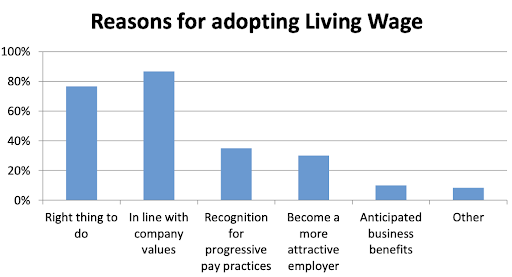
The main reasons stated for adopting the Living Wage policy are it being in line with the company values and it being “the right thing to do” (see graph below).
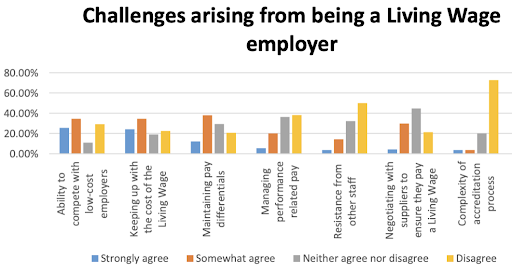
The major challenges that arise from being a Living Wage employer include the ability to compete with low-cost employers and keeping up with the cost of the Living Wage (see graph below).
In order to replicate the Living Wage campaign, employers must first communicate their commitment internally before they publicize said commitment externally. This will help in preparation for organizational changes and clarification about which specific commitments are most important to the company. Organizations must develop strategic rationales about why they want to be accredited so that the commitment is genuine and deliberate. Once committed and implementing business changes such as price increases for customers in phases, companies can also encourage related businesses such as suppliers to also adopt the policy. Ultimately, if businesses are unable to pay staff what they need to live on, there is a problem with their business model. The Living Wage is a long-term investment that is moral, smart, and sustainable.
In order to concoct an equitable and effective Living Wage policy, city councils can utilize resources such as the Eurofound Research Report on the Concept and Practice of a Living Wage, the Living Wage Foundation, or consulting firms such as C-NAPSE with expertise in city innovation, entrepreneurship, and technology. Local governments have the opportunity to advocate for a wage that ensures workers and their families can afford a decent standard of living while encouraging businesses to adopt this living wage through a voluntary accreditation program. While it would require careful consideration of feasibility for businesses, especially smaller ones, the long-term benefits of a more equitable and stable local economy, along with enhanced social cohesion, make a living wage a compelling choice for cities.
Other best practices that relate to the Living Wage campaign include: Inclusive Employer Toolkits, Voices of the Underrepresented Report, Workforce Data Equality Guide, London Benchmarking Tool, Guidance for SMEs, London Datastore, and Workforce Integration Network.