
Robotics in Healthcare: inside the 3rd Lisbon Robotics Talk
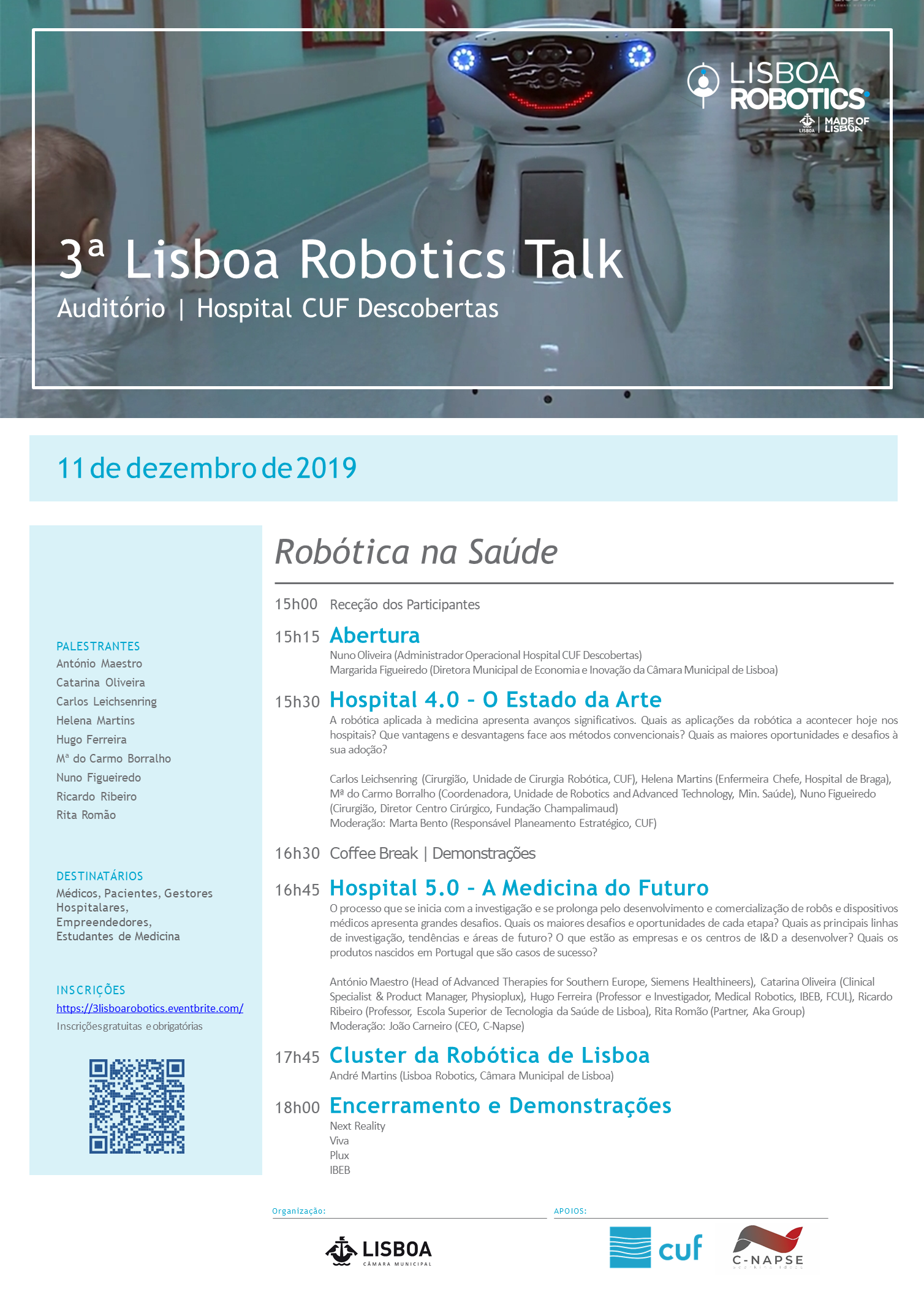
On 11 December 2019, C-NAPSE helped organise the 3rd Lisbon Robotics Talk at the Knowledge Centre of Hospital CUF Descobertas — an initiative of the Lisbon Robotics Cluster, promoted by the Lisbon City Council and run in partnership with CUF (José de Mello Saúde).
The Lisbon Robotics Talks bring research and industry together around a single, concrete question. For this edition the question was simple and consequential: where does robotics genuinely add value in healthcare — and what will the next decade of hospitals look like?
Why robotics in healthcare matters
Healthcare is one of the most demanding environments for any technology: the margin for error is small, the regulatory bar is high, and adoption only sticks when it demonstrably improves outcomes or frees clinicians to focus on patients. Robotics and connected sensing are crossing that threshold — in surgical assistance, logistics and disinfection, rehabilitation, remote monitoring and assistive care.
The event framed this as a trajectory from Hospital 4.0 — today’s state of the art, where automation and data already support clinical work — to Hospital 5.0, a more human-centred model where technology quietly augments care rather than replacing the people who deliver it. That framing matches how we approach technology with public-sector partners: evidence first, people always.
The programme
Two expert panels anchored the afternoon, followed by live demonstrations from leading Portuguese technology and research organisations.
Panels
- Hospital 4.0 — The State of the Art
- Hospital 5.0 — The Medicine of the Future
Live demonstrations
- PLUX — Wireless Biosignals
- Next Reality — Augmented Reality Studios
- IDMind — service and social robotics
- EPL — Mechatronics & Robotics
- IBEB — Institute of Biophysics and Biomedical Engineering
- SPMS / SNS — Portugal’s shared health services
Watch
A short trailer from the day, on C-NAPSE’s channel:
Planning a public-sector innovation programme?
We help municipalities, hospitals and public authorities turn proven technology into funded, deliverable projects.
Talk to our public-sector team